✓ Correct Training Systems
✓ Correct Training Systems       1300 769 937
  • Home
    • About CTS
    • Gary Kennedy Profile
    • Lisa Owens Profile
    • Tina Pickering Profile
  • Training Courses
    • Onsite Customised Training
    • Implement HACCP Food Safety Systems
    • Audit a Cook Chill Process
    • Food Labelling Requirements
    • Participate in Food Recalls
    • HACCP Recharge
    • VITAL and Allergen Management Combined
    • Allergen Management Skills for Food Production
    • Allergen Management Skills in Food Service
    • Short Shot Sessions
    • Food Safety Supervisor
    • Microbiology Demystified
    • Food Safety Awareness Refresher
    • Cook Chill Operations
    • Short courses Regulatory Training Direct
  • Calendar
  • Register
  • Resources
    • Student Resources, Guidance materials
    • USI Information
    • CTS Student support. Student handbook >
      • National Recognition, RPL and Credit Transfer.
      • Language Literacy and Numeracy
    • Consumer Protection >
      • Complaints and Grievances Policy
      • Appeals Policy
      • Terms, Fees and Refunds
      • Harrassment Policy
      • Privacy Policy
    • COVID Safety Protocols
  • ✓ Contact
  • Client Training Resources
  • CTS specific Training 11
  • New Page

Weight and measures for food labelling

19/8/2022

 
There are detailed requirements for labelling in the national trade measurement laws to make sure that the buyer is properly informed.
 This guidance includes positioning, size of font, correct terms and abbreviations.
https://www.industry.gov.au/data-and-publications/guide-to-the-sale-of-pre-packaged-goods/labelling-requirements​

Getting your claims right

19/8/2022

 
FSANZ guidance document for getting your health and nutrition claims right
getting_your_claims_right.pdf
File Size: 2065 kb
File Type: pdf
Download File

Nutrition panel information and guide

19/8/2022

 
Nutrition Panel Information- Australia
​Australia has a distinct format that is required for the Nutrition Information Panel for food product sold in Australia.
The format and requirements are different to other countries.


This page provides some general advice on how to develop a Nutrition Panel in the FSANZ format.
Use this information as a guide a to learn about Nutrition panels, so you can prepare a Nutrition Information panel with accurate and correct information in a compliant Australian format.

Alternatively contact Correct Food Systems to develop a Nutrition Panel for your product.

All packaged food has to have a Nutrition Information Panel except:
  • Food sold at fund-raising events
  • Alcoholic beverages, water, vinegar
  • Herbs, spices, salt, herbal infusions, tea, coffee
  • Food Additives (e.g. flavourings, colours)
  • Fruit, vegetables, meat, poultry or fish where they are one category of ingredient
  • Small Packages
Contact Correct Food Systems or FSANZ if you are unsure if your product requires a Nutrition Information Panel.

Format of the Australian Nutrition Panel
All packaged food must have a nutrition panel in the Australian format covering:
  • Energy (kilojoules or kilojoules and calories)
  • Protein (grams)
  • Fat, saturated fat (grams)
  • Carbohydrate, sugars (grams), and
  • Sodium (milligrams or mmoles)
  • Any other nutrient declared or identified on the label or package (appropriate unit).
​The measures must be expressed both per serving size and per 100g or 100mL.
If a food is prepared using another food (e.g. milk on cereal), then another column can be added for the combined nutrient figure.

There are special rules about making claims for:
  • Poly or monounsaturation
  • Omega-3
  • Low joule
  • Lactose reduction
  • Presence of gluten
  • Salt, sodium or potassium level 
Nutrition testing of products by a laboratory to verify nutrition information is not generally required for product for general retail sale within Australia.

The FSANZ website [www.foodstandards.gov.au] operates a free web based nutrition panel calculator that can calculate and build your nutrition panels free of charge.
This can be found at :
http://www.foodstandards.gov.au/industry/npc/Pages/Nutrition-Panel-Calculator-introduction.aspx
There is a quick start guide to show you have to start building your recipe/ ingredient lists within the calculator.
An overview of the steps are:
1. Name your recipe/ product
2. Add your ingredients and amount- use the database of foods within the calculator or information you have about your ingredients from the supplier, in the Product Information File ( PIF) or product spec.
Note not all liquids in mls weigh the same. Use the list of specific gravity to work out the weight of common liquid foods.
3. Enter the final product weight or percentage weight change in the calculator
Be aware that some food loses weight when it is cooked/ baked /processed. Other foods may gain weight or liquids during processing.
See Weight change factors
4. Enter the serving size and number of serves in the package.
Calculate and save the Nutrition Panel that was calculated

NSW FA guidance for food labelling

19/8/2022

 
General guidance for food labelling 
labelling_general_requirements_nswfa.pdf
File Size: 182 kb
File Type: pdf
Download File

NSW Food Authority labelling assistant and guidance for food labelling

19/8/2022


The NSW Food Authority have a interactive app to assist and provide guidance for food labelling
https://www.foodauthority.nsw.gov.au/food-labelling-assistant 
​
 There is also guidance at to what is on a label in a fun easy to understand format.
https://www.foodauthority.nsw.gov.au/food-labelling/how-read-label/whats-on-a-food-label 

FSANZ - Food labels what do they mean

19/8/2022

 
FSANZ simple guide to components of a food label
fsanz_food_label_what_do_they_mean.pdf
File Size: 364 kb
File Type: pdf
Download File

Guide to Food labelling and Allergen Management

19/8/2022

 
The AFGC Food Industry Guide to Allergen Management and Labelling offers guidance in managing allergens incorporating the changes to FSANZ 1.2.3 and schedule 9. Plain English Allergen Labelling.- required by 2024.
​This is a very comprehensive guide to allergen management and labelling 
New to the Guide in 2021 are:
  • Managing and communicating changes to the allergen status of a packaged food
  • Handling consumer contact regarding allergens in products
figaml_april_2021_.pdf
File Size: 8979 kb
File Type: pdf
Download File

Plain English Allergen Labelling

6/4/2021

 
See our Utube interview with Gary Kennedy explaining this change.
Watch our short interview for an overview of the changes.

Late February 2021 the FSANZ Code was amended to introduce new requirements for the labelling of allergens in food, sold in Australia. FSANZ approved Proposal P1044 Plain English Allergen Labelling (PEAL).
Businesses have 3 years (till 25 February 2024) to adjust their product information and labels to meet the new requirements. There is a further 2 years stock in trade period.


These requirements change how allergen information is to be declared.
Products for sale in Australia will have specific allergen information, in a specific format, specific wording and terms, in bold font, in a specific location on food labels.

PEAL changes include
  • Allergen identification in the Ingredients List, for each ingredient
  • Required specific names for making allergen declarations
  • Declaration of allergens in processing aids used
  • Bolded format of specific allergen words
  • In a size of type no less than that used for other text
  • Molluscs as a new allergen category
  • Specific nut type must be named rather than "nuts" or "tree nuts", eg cashew, hazelnut. almond
  • Specific cereal type must be named rather than "cereals", eg wheat, barley, oats in the ingredient list
  • ‘Wheat’ must still be declared when it is present in food, irrespective of whether gluten is present
  • Specific declaration of gluten in the separate allergen statement
  • A separate allergen statement in addition to the Allergens declared in the Ingredients list
  • Allergen information clearly legible, and same size font so as to contrast distinctly with the background of the label
  • FSANZ has specified the mandatory terms that must be used in both the Ingredient List and the Allergen Declaration Statement. In some cases - where gluten is present in the specific cereal, gluten must be named in the Allergen Declaration Statement
Note: This is not an exhaustive list of all the changes.

See the Plain English Allergen Labelling webpage at Correct Food Systems

Further information can be found at FSANZ in Standard 1.2.3 ( link to Standard 1.2.3), and Schedule 9 Mandatory Advisory Statements (link to Schedule 9) and in the proposal  approval report.

Country of Origin Food Labelling Style Guide and fact sheet

25/5/2016

 
Here is the Style Guide to help the apply the correct use of the new Country of Origin label formats.
The fact sheet provides simple guidance advice.
country_of_origin_labelling_style_guide_pdf.pdf
File Size: 2902 kb
File Type: pdf
Download File

160506_factsheet-diis-cool.pdf
File Size: 578 kb
File Type: pdf
Download File

Country of Origin Food labelling Standard 2016

19/4/2016

 
The Australian Government has announced and released a new Standard for labelling food Country of Origin. This is effective from 1 July 2016, with a 2 year transition period.
Download a copy of the new standard here.
160418_coo_food_labelling_standard.pdf
File Size: 1567 kb
File Type: pdf
Download File

Label buster

24/3/2016

 
Queensland health has a detailed guidance sheet on labelling information.
Available as a download . https://www.health.qld.gov.au/publications/portal/food-safety-labelling/label-buster-guide-bus.pdf
​

FSANZ Link to Food Standards Code 1.2 Labelling

29/1/2016

 
Picture
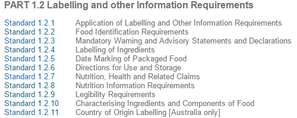
Use this link (Click here) to access the FSANX Food Standards Code on Labelling.
Chapter 1 General Food Standards
Part 1.2 Labelling and other information Requirements

Labelling- General Requirements NSWFA

29/1/2016

 
Simple outline on General Requirements for food labelling by NSW Food Authority.
Click here

Labelling self assessment checklist NSWFA

28/1/2016

 
Very simple checklist for labelling compliance by NSWFA. This aligns to the FSANZ labelling standard code. 
Click here

Food Packaging Materials

9/1/2016

 
Packaging and containers used to store food ,  in direct contact with the food, need to be suitable and ‘food grade’. This useful guideline by NSW Food Authority details the requirements of food grade packaging, surfaces and containers.
(Click here) 

Picture

Food Labelling Guideline - NSWFA

9/1/2016

 
All food labels must conform to the Australia New Zealand Food Standards Code.
The NSW Food Authority has a useful resource on the labelling requirements for packaged foods.
(click here)

Declaring Allergens in packaged food

9/1/2016

0 Comments

 
The Food Standards Code requires all food businesses in NSW to provide information about the eight most common allergens on food labels of packaged foods: 
The NSW Food Authority has a simple guide on Standard 1.2.3 Mandatory Warning and Advisory Statements and Declarations. ( click here)
0 Comments

    Categories/
    Training Products

    All
    Cook Chill
    Food Safety Standards
    Food Safety Supervisor
    HACCP
    Implement HACCP
    Industry Information
    Labelling
    Recalls
    VITAL

    Resources,
    Fact sheets, Guidelines, Standards, Information. 
    (To access learning resources for our training products use the Categories above,
    click on the links to download the resources)

    Posted by Lisa Owens

    Archives

    January 2024
    October 2023
    August 2023
    June 2023
    November 2022
    August 2022
    June 2022
    May 2022
    April 2022
    April 2021
    February 2020
    February 2019
    May 2018
    March 2018
    January 2018
    February 2017
    January 2017
    November 2016
    October 2016
    June 2016
    May 2016
    April 2016
    March 2016
    February 2016
    January 2016

    RSS Feed

Picture

Correct Food Systems-
Our associate company
"Your partner in Food Safety Compliance"

RTO 88118

Training and Assessment 
Your site, our site or virtual meetings online
  • HACCP Training
  • HACCP Refresher
  • Food Labelling
  • Food Recall
  • Food Safety Auditing
  • Cook Chill Operation's
  • Specialist client training sessions

Contact Us

Subscribe to the Correct News

Subscribe to our bimonthly food safety e -Newsletter
Join Now